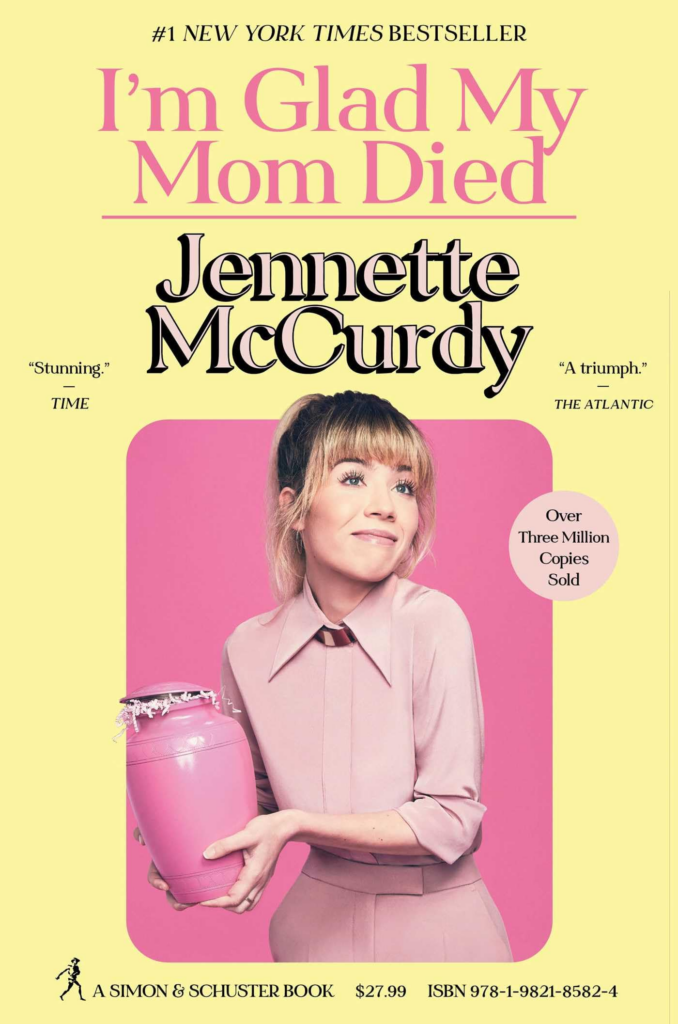
Book Specs 📖
- Author: Jennette McCurdy
- Genre: Memoir
- Publisher: Simon & Schuster
- Format: Audio
One Sentence Synopsis🔖
Former Nickelodeon child actor reveals her abusive relationship with her mom.
Notes/Thoughts📝
- l’m reading this a second time for work book club and we’re doing audio this round since the readers said it’s read by the author (the only time I’ll give audio a chance) I still prefer text to audio/ The stickiness factor is not great with audio because annotating while writing helps with retention, but it is interesting hearing the intonation in the author’s voice in how she wants her story told.
- Listening this time, the unnaturalness of a “child actor” was prominent. The subject matter they have to perform, the ability to cry on cue, and the fact that this kid is probably just a stand-in for their parent’s unmaterialized dream is heartbreaking. From a young age, children our learned to not trust themselves, and instead to develop a mask to fit in with whatever narrative adults demand them to adopt. It’s no wonder why so many child actors end up nutcases once they are no longer children/famous. Imagine experiecing your peak as a child and wanting to go back to that period in our life (because that’s the only time your parents/the world paid attention to you). Where growing up after being a child is a living nightmare and a dead-end journey.
- Parenthood is a slippery slope. There’s selflessness, then projected dreams on a mini-me, then there’s abusive parenting. No one wants to be in the third category, everyone wants to be in the first. The reality is, even the best parents had a mix of 1 and 2. Camp 3 was real bad and sometimes used as a self-perpetuating flag for victimhood, The sad truth: there almost always is love in the mix, and that’s what makes the whole parent-child relationships frought with complexity. How can the person that claims to love you also be the same person that teaches you how to hate your body, ignore your intuition, and abuse you? McCurdy’s mom died from cancer in the book, but for those of us that have parents that are not dead, or are dead while alive, how do you continue to rebuild the narrative of yourself after you’ve seen your parents for who they really are? I forgot about the power of the last chapter. McCurdy speaks the plain and ugly truth of what her mother put her through while also expressing the grief she still experiences from missing her. Life does get better, but the complexity remains and yet we must learn to define a new narrative for living.
- In the context of this book, McCurdy says at the end that putting her mom on a pedestal was what set her up for failure but I think that what failed her was her mother. Children naturally look towards caretakers for guidance, as examples for how they should behave and think. Literally, looking up because adults are so much bigger, and supposedly knowledgeable. Alas, this dependency leads to lack of understnading the self (bodily and spritual needs), which consequently results in poor boundaries and coping mechanisms when things don’t feel right in our body. In our formative years, the mother is a primary role model that set us up with relational attachment styles, and how we refer to ourselves. Unfortuantely, we still haven’t developed a bar humans from procreating if they haven’t passed an empathy/love test, but I guess that means we won’t feel so along in our generational sufferings if we continue to share our stories.
- The significance of the mother in the ‘After’ section when McCurdy’s mom had died was HEAVY. I felt the shadow of her mother and in some weird way missed her presence? I noticed that McCurdy’s anxieties that she stuffed back inside herself transferred, from her OCD, to her eating disorddr, these were all just different versions of the same inexpressible anxieties that took on a different coping mechanism.
- The therapy sessions with Jeff (chapter 81) talks about the shame spiral. There’s the guilt and frustration that we feel after we make a mistkae but the shame is what we heap on top that keeps us stuck. What he called a “slip” that turns into a “slide”. We’re all susceptible to this and it’s important to remind ourselves that it isn’t the end of the world and the “slip” is just a “slip”. It doesn’t have to keep going. We can decide where the buck stops.
“Quotes”🗣
“I don’t like knowing people in the context of things. “Oh, that’s the person I work out with. That’s the person I’m in a book club with. That’s the person I did that show with.” Because once the context ends, so does the friendship”
“Why do we romanticize the dead? Why can’t we be honest about them?”
“I feel like the world is divided into two types of people: people who know loss and people who don’t.”
“I was conditioned to believe any boundary I wanted was a betrayal of her, so I stayed silent. Cooperative.”