Book Specs 📖
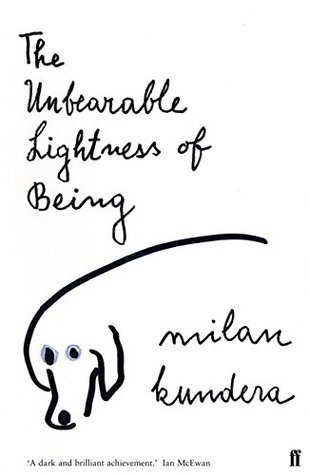
- Author: Milan Kundera
- Translator: Michael Henry Heim (from the Czech)
- Genre: Philosophical Fiction
- Publisher: Harper Perennial
- Pages: 314
One Sentence Synopsis🔖
Philosophical exploration of “lightness” and “weight” in romantic relationships between four interconnected main characters and a dog in late 1960 Soviet occupied Czechoslovakia.
Notes/Thoughts📝
- This book reminded me of the author and philosopher, Alain de Botton who I used to be obsessed with. de Botton uses the narrative of a complex relationship as a backdrop against philosophical topics which seems to be the same technique Kundera uses. This is probably the first book I’ve read that’s based in what is now the Czech Republic (my friend had to correct me when I said Czechoslovakia)
- I cheated a little because I was struggling with the concept of “eternal return” from the beginning of the book. I knew there was something profound being said from Nietzsche, that “everything recurs as we once experienced it, and that the recurrence itself recurs ad infinitum!”. Whereas if life were to recur infinitely, each action/consequence would be unbearably heavy. The inability to compare our alternate lives makes our experience/actions seem meaningless, hence the quandary of living.
- Tomas comments that reflecting on his relationship with Tereza gave him more joy than the agony of experiencing it. Thinking Fast and Slow mentioned the concept of the remembering self vs. experiencing self, and how we can separate people into these camps. In my opinion, I see this as a lens/tool we can use to shift our perspective. Although I derive more pleasure from “remembering” or reminiscing, I can also enjoy life in the moment as it is happening.
- Loved the analogy of Beethoven’s “difficult resolution” (Ess muss sein! = It must be so!) and how greatness is achieved when you “bear your fate”. Another powerful example of the lightness you can feel through weight.
- Reviewing the passage about coincidences as small acts of beauty. A couple of weeks ago, I had a chat with friends and we disagreed about the nature of a coincidence and aha! so glad Kundera agrees with me that seeing event as happenstance vs. rare coincidences is the difference life and a beautiful life. Instead of it just “happening”, it becomes a “motif”, which may take on a “permanent place” of a large scale work in the composition of your life. Kundera, you poet!! i
- I have realized that the books I have read that include dogs as the idylls of love are probably written by the best people (yes, referring to Jon Fosse who created Bragi the dog in Septology ). Through my own experience of meeting my one true love, Gucci, it’s hard not to be poetic when you’ve experienced a dog’s love Humans could never.
“Quotes”🗣
“We can never know what to want, because, living only one life, we can neither compare it with our previous lives nor perfect it in our lives to come. “
“Love begins with a metaphor. Which is to say, love begins at the point when a woman enters her first word into our petic memory.”
“Love does not make itself felt in the desire for copulation but in the desire for shared sleep.”
“For there is nothing heavier than compassion. Not even one’s own pain weighs so heavy as the pain one feels with someone, for someone, a pain intensified by the imagination and prolonged by a hundred echoes.”
“Anyone whose goal is “something higher” must expect some day to suffer vertigo. What is vertigo? Fear of falling? Then why do we feel it even when the observation tower comes equipped with a sturdy handrail? No, vertigo is something other than the fear of falling. It is the voice of the emptiness below us which tempts and lures us, it is the desire to fall, against which, terrified, we defend ourselves.“
“…it is questions with no answers that set the limits of human possibilities, describe the boundaries of human existence.”
“Love is the longing for the half of ourselves we have lost.”
“the novel is not the author’s confession; it is an investigation of human life in the trap the world has become.”
“It was sad, what she said, yet without realizing it they were happy. They were happy not in spite of their sadness but thanks to it. they were holding hands and both had the same image in their eyes: a limping dog who represented ten years of their lives.”
“Perhaps the reason we are unable to love is that we yearn to be loved, that is, we demand something (love) from our partner instead of delivering ourselves up to him demand-free and asking for nothing but his company.”
“Human time does not turn in a circle; it runs ahead in a straight line. That is why man cannot be happy: happiness is the longing for repetition.“
“Sometimes you make up your mind about something without knowing why, and your decision persists by the power of inertia. Every year it gets harder to change.”