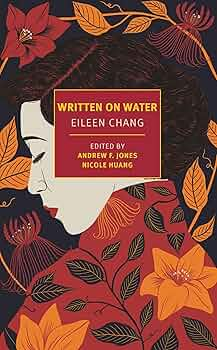
Book Specs 📖
- Author: Eileen Chang
- Genre: Essays/Memoir
- Publisher: New York Review Books (NYRB)
- Pages: 244 pages
One Sentence Synopsis🔖
Chang revisits the fragmentary memories of childhood and cultural influences (fashion, cinema, Peking Opera, etc. ) that shaped her life as a woman and writer in war time Shanghai and Hong Kong.
Notes/Thoughts📝
- This felt like a more lighthearted Chinese version of Ernaux’s style of writing. Much of the books I read are westernized. Naturally reading in English limits me to books that are originally written in English or to books that have been translated into English. Reading more translated works has made me realize the shortage of Asian authors in my reading repertoire. Reading Chang gave me a familiar feeling of being connected to my mom – I could recognize the very “Chinese” elements in her book, which my mom has told me through her own stories of being a Chinese woman. I recognize the same sentiments in Chang’s writing. It’s a sort of familiarity I never knew that I needed – how exciting that there’s a whole world of literature to be discovered and I’m only just discovering the tip of the iceberg!
- The chapter What is Essential is that names be Right was one of my favourites. The link between naming and creation, as a means of determining your destiny is one that is lost in Western culture. So what does my English name say about me? What does my Chinese name say about me. And that I have two names, those are two sides of me. It was cool to learn that Eileen Chang’s mom had named her in English first and transcribed her name into Chinese, hence 張愛玲! It reflected how she wrote her pieces, first to an English audience in her Chinese voice. There are so many books about the importance of a name (in Aboriginal cultures as well), what we call into existence has significance. Something to pay attention to!
- I loved the illustrations in the book by Chang!! They added so much more to each chapter and you could see another side of her personality through her drawings. Might have to start sketching too!
- As someone that wants to write more this year, I appreciated all the writing tips that were dispersed throughout the book. On page 18, Chang speaks about creating an “equivocal contrast” (p. 18) and writing from a state of stability. The latter is what we feel nowadays where we seek to shock, excite, dramatize but often this lacks substance and you leave the novel feeling unsatisfied. It reminds me why novels that don’t have the large story arc but are focused on the subtle undulations of everyday life are often more moving and create what Chang calls a “revelation”. And of course the open-endedness of a book, where you leave with more questions than answers, an open field to write the rest of the story for yourself…often mimicking real life, is my favourite way to end a story. Will need to put a Chang fiction as a TBR this year – I’m already hooked on her non-fiction!
- Throughout all the chapters of the book and as mentioned in the Afterword, you see the great breadth of knowledge Chang possesses that is on display. This is reminder of the importance of “showing” rather than “telling”. We forget that the power of allowing people to make their own conclusions is an act of co-creation and allowing people to create their own thoughts about a subject. Saying things explicitly becomes a matter of lacking imagination. I fear that in the age of AI as our minds become lazier, that we forget how to critically think and we lack the patience to find ways to communicate without “telling.” Even in receiving messages, we all want to autonomy to be able to interpret the message for ourselves. Question for myself: how do I communicate without “telling”?
“Quotes”🗣
“For people who are too shy to speak, clothes are a kind of language, a “pocket drama” they can carry wherever they go.”
“The transformation of life into drama is unhealthy. Growing up in the culture of the city, many of us see pictures of the sea before we see the sea itself; we read of love in romance novels long before we experience it in life. Our experience is quite often secondhand, borrowed from artificial theatricals, and as a result, the line between life and its dramatization becomes difficult to draw.”
“All of us must live within a certain historical era, but this era sinks away from us like a shadow, and we feel we have been abandoned. In order to confirm our own existence, we need to take hold of something real, of something most fundamental, and to that end we seek the help of an ancient memory, the memory of a humanity that has lived through every era, a memory clearer and closer to our heats than anything we might see gazing far into the future.”
“A real revolution or a revolutionary war, I believe, should be as emotionally unguarded and as able to penetrate into every aspect one’s life as romantic love. “
“To give someone a name is a simple and small-scale act of creation.”
“If there is something you want to do, do it right away: even then you might already be too late. Man is the most changeable of creatures.”
“In our selfishness, and emptiness, in our smug and shameless ignorance, every one of us is like all the others. And each of us is alone.”
“It is better to walk ten thousand miles than to read ten thousand books.”
“Might it be that in this life that moment of letting go is the very loveliest?”
“But I believe that writers themselves should be like trees in the garden, growing naturally within its confines, with their roots extending deep into the ground below. As they grow, their viewpoint will begin to grow wider, and as their field of vision expands, there is no reason why they shouldn’t be able to develop in new directions, for when the wind blows, their seeds will disperse far into the distance, engendering still more trees. But that is the most difficult task of all.”
“True immersion in the atmosphere of life usually takes place spontaneously. It isn’t something that can be forced or willed into being. All a writer can strive for is to live with integrity. A real writer can only really write about what he himself thinks. He will write about what he can write; what a writer should or should not write is ultimately besides the point”