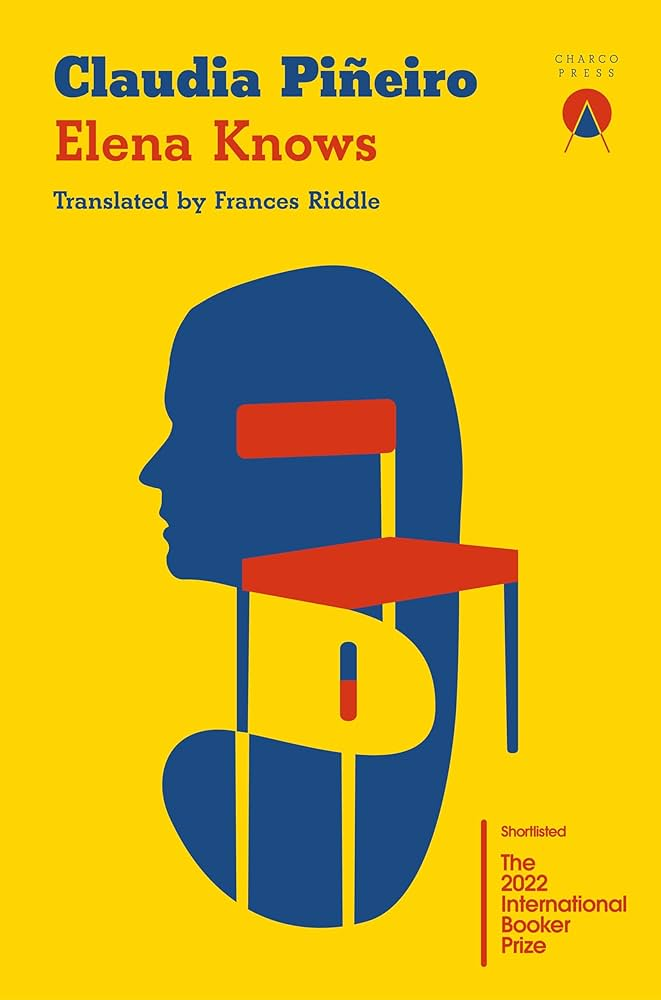
Book Specs 📖
- Author: Claudia Piñeiro (Translated by Frances Riddle)
- Genre: Literary Fiction
- Publisher: Charco Press
- Pages: 143 pages
One Sentence Synopsis🔖
Elena, a mother with advanced Parkinson’s, investigates her daughter’s suicide.
Notes/Thoughts📝
- Structure:
- The book is divided into three parts for the four pills that Elena takes everyday for Parkinson’s (Morning, Midday, Afternoon). Interestingly the first pill is omitted before the morning which may explain the personal afflictions that are not readily expressed/verbalized in the early hours of the day – the million lonelinesses we feel when suffering through something difficult. The Afterword was helpful in explaining the story’s structure as paying homage to the classic Greek tragedy.
- I noticed the dialogue in the book was written in a stream of consciousness paragraph style where you could hear the distinct voices (on most readings) but at other times, the voices were difficult to distinguish. My interpretation is that this mimics the understanding of speech as someone who suffers from Parkinson’s.
- Elena
- Piñeiro cleverly forces the reader to take on Elena’s perspective as a Parkinson’s patient with her mentalprocesses (obsessively reciting street names), deterioting motor skills (describing how she moves her legs, sits down, stands up), line of sight (only being able to see the view of people’s shoes and not expressions).
- Elena names Parkinson’s as Herself or ‘the fuckng whore illness’ to express the personal expression of her anger and resentment as someone that has to suffer the illness. It is part of her redemptive act to reclaim herself, the little parts of herself where she still retains control.
- Themes
- Motherhood
- Although you’ve known them for your entire life, how much do you KNOW them?
- What is our societal value if we do not want to become mothers/wives?
- Abortion, the Church and the ownership of the womb – who ultimately decides the value of life, who receives redemption
- Learned from the Afterword that there are some places like Argentina where abortion was only recently legalized. Living in Canada, I forget sometimes that our own abortion laws were only fully legalized in 1988. Our previous generations fight for our rights and as time passes, we forget that in a patriarchal society women’s rights were not afforded just a couple of decades ago. This is an interesting moral dilemma as more adults decide to not have kids and we move towards a more secular society where we move away from the Church as a central decision maker in Western society. Clever use of being trapped in one’s body from different character portraits – Isabel having to bear a child against her will, Elena having to carry Parkinson’s in her body, and Rita taking her own life to escape caregiver/societal handcuffs.
- Infirmity/illness/ageing
- Rita mostly appears in the book as full of anger and resentment but is also representative of the contempt we have of the aging and the disabled. It holds up a mirror to our own humanity, of what we can become. I sense the same impatience through Rita at certain points in the novel and also felt shame for feeling the way I did. There’s weight in both perspectives and begs us to ask the question of what creates value in our today’s society. When technology develops at lightspeed and we know longer seek wisdom from our grandparents but from AI learning models, what happens to those that can’t catch up? Is compassion a practice vs. something innate in all of us?
- Motherhood
- Other notes:
- My favourite moment is at the end of the book when both Isabel and Elena are petting the cat as two people that have experienced the same loss as mothers in different ways. It’s a quiet acknowledgement of forgiveness and calm that needs no words – the best type of understanding.
- In the book there’s “thinking” vs. “knowing” and ultimately not knowing. The whole journey that Elena takes to investigate her daughter’s suicide by finding Isabel is in fact the great unveiling that there is so much that she does not know about her daughter and herself. It’s a humbling story that reminds us that we can accumulate knowledge and experiences, but someone else’s experience is not something we will ever truly understand. There is a space that must be afforded for not understanding
“Quotes”🗣
“She doesn’t have a timetable. Her time is measured in pills.”
“Never isn’t a word hat applies to our species, there are so many things that we think applies to our species, there are so many things that we think we’d never do and yet, when put in the situation, we do them.”
“People confuse thinking with knowing, they let themselves confuse the two.”
“A memory for details, Elena knows, is only for the brave, and being cowardly or brave is not something one can choose.”
“…you only know something once you’ve experienced it in your life, life is our greatest test.”