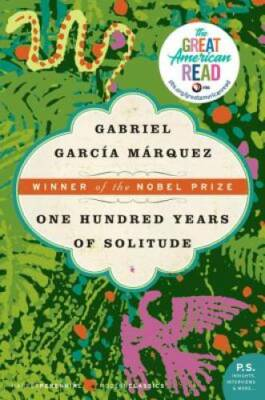
Book Specs 📖
- Author: Gabriel García Márquez
- Genre: Magical Realism, Epic Fiction
- Publisher: Harper Perennial Modern Classics
- Pages: 448
One Sentence Synopsis🔖
Follow the tragedy of seven generations of the Buendia family as they repeat their histories, experiences, and passions.
Notes/Thoughts📝
- There is a lot in here to process. We are talking about “100 Years’ of Solitude” so pardon me if I need a minute to digest. Two major themes that I can start with
- On solitude – Solitude in Márquez’s book either drove people to be happy in their solitude (at least for awhile), make bad decisions to escape being alone, or find a “shared solitude”. We’re quite familiar with the first type of solitude. It’s become a dogma in the Western World to priortize self-care and be independent. Inner peace is a discipline and a practice but I think the darker/natural side of our humanity is the innate chaos we all possess. Nietzsche believed that our inner chaos was the source of our creativity, our passions, and our personal growth. So thinking of our solitude as a journey that requires us to express our most inhinged inclinations is the path that will get us to a solitude beyond ourselves, beyond chaos, to the most fulfilling solitude where we can be happy as individuals, and also share in this experience with others. WOW, writing really does give you clarity!!!
- On time as a circle – This one was packed with a punch because of the generational echoes in names, actions, regrets, and realizations. I made a note that “Ursula died!!!” on page 342. Before she died “She ….mixed up the past with the present in such a way that in the two or three waves of lucidity that she had before she died, no one knew for certain whether she was speaking about what she felt or what she remembered.” She’s described as a “newborn old woman”, a “cherry raisin” and “shrinking into the size of a fetus”. Time is an interesting concept when seen through the lens of progress and civilization. We think we advance but the truth is we do, but more on a technological leve. The human journey is very much the same recycled story told from different mouths. We are very similar in our search for meaning and our afflictions. Perhaps turning to eachother, allowing our inner chaos to show is how we reach nirvana/ our shared solitude. The goal is the love that Petra Cotes and Aureliano Segundo discover :’)
- I just saw an IG reel about the need for character charts when reading Classics, and it could not be more true! I flipped back and forth to reference Jose Arcadio Buendia, Jose Arcadio, and Arcadio (these are all people from different generations). It’s especially poignant here because the author intentionally mixed the names of ancestors with their progeny to reinforce the repetition of our characters and of our history. That as much as we want to be the black sheep, you very much are just a regular degular sheep (sorry homie). The saying, the apple[/chestnut] doesn’t fall from the [chestnut] tree, is very much a consistent theme here as you move through the different generations of the Buendia family.
- I’m going to interpret the incestual component of desire/love in the book as a primordial/animalistic instinct of humans, or a very natural “sin” that we commit due to our passions. What Ursula refers to as the pig’s tail, is the fear of nature’s wrath on incestual relationships. In the book, there is no ignorance of the immoral love affairs between family members. Essentially humans are barbarians. Even Aureliano, the scholarly man that read everything and expressed that everything is known, made love with his aunt – and honestly, I don’t know how much more we progressed as a society other than become more judgemental of our human nature.
- Symbols – there are many more mentioned in the book, but let’s start small so we don’t take 100 years to write this
- Red Ants – Near the last third of the book, red ants appear as the house falls into a state of decreptitude and disrepair. My interpretation of red ants is that the smallness of bad decisions compounded over time can destroy a strong foundation. We are no different than insects once we are in the ground. Reminds me of the ants in Beef Season 2!! (poster below
- Writings/Parchments – José Arcadio Buendía, Aureliano Segundo, and Aureliano Babilonia (illegitimate son) all have a fixation on deciphering writings and in the last two pages of the book, Aureliano Babilonia discovers discovers the fatal end of the family line. I can’t put this into words yet but it feels to me like the classic human search for the secret of life/the world, only to understand that we could never outlive our own destiny.

“Quotes”🗣
“Children inherit their parents’ madness”
“He was weary of the uncertainty, of the vicoius circle of that eternal war that always found him in the same place, but always older, wearier, even more in the poisition of not knowing why, or how, or even when.”
“…the search for lost things is hindered by routine habits and that is why it is so difficult to find them.”
“…time was not passing…but it was turning in a circle.”
“She felt so old, so worn out, so far away from the best moments of her life that she even yearned for those that she remembered as the worst….”
“It’s enough for me to be sure that you and I exist at this moment.”
“He dug so deeply into her sentiments that in search of interest he found love, because by trying to make her love him he ended up falling in love with her. Petra Cotes, for her part, loved him more and more as she felt his love increasing, and that was how in the ripeness of autumn she began to believe once more in the youthful superstition that poverty was the servitude of love. Both looked back then on the wild revelry, the gaudy wealth, and the unbridled fornication as an annoyance and they lamented that it had cost them so much of their lives to find the paradise of shared solitude. Madly in love after so many years of sterile complicity, they enjoyed the miracle of living each other as much at the table as in bed, and they grew to be so happy that even when they were two worn-out people they kept on blooming like little children and playing together like dogs.”