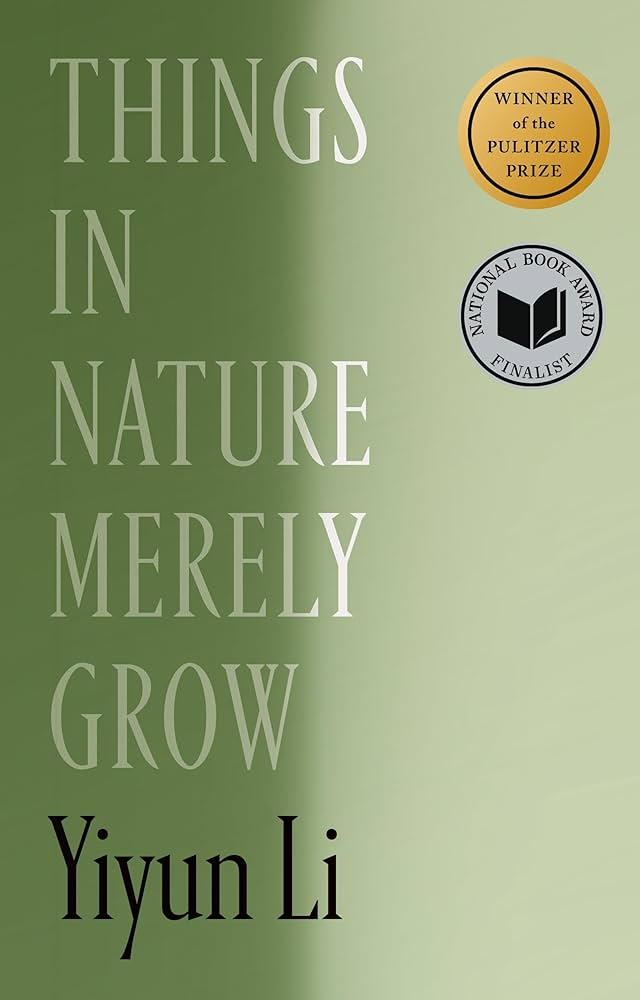
Book Specs 📖
- Author: Yiyun Li
- Genre: Memoir
- Publisher: Picador
- Pages: 172
One Sentence Synopsis🔖
Yiyun Li shares the tragic loss of her sons to suicide.
Notes/Thoughts📝
- I have read many books about grief. After losing my dad and my daughter (Gucci), this book felt like the friend that I needed when I was lost. What I love about authors is the attention to diction, the precision to which words are used. The word ‘grief’ as a way to process loss is interesting. We expect grief to be a stage of sadness where the aggrieved is removed from the “normal world” and once ready is reintegrated into society. Li argues that this is an unreality. Losing someone you love is likened to an “abyss”, a point where all time is related to that one point in time, and where this all-encompassing loss is a boulder that you carry with you for the rest of your life, like Sisyphus’ fate for eternity. Li says that while she is in this abyss, she should make a ‘habitat’ out of it. Sometimes I feel like that too, maybe this is where the loneliness comes from.
- Probably my favourite line in the book “And people who intentionally or unintentionally hurt other people: I have come to the conclusion that they cannot help themselves, and they cannot be helped. This is only an acknowledgement, and it is not understanding or forgivenesss, neither of which I will give” It made me love her more for being unabashedly candid about people that lack the care to talk to people who have experienced loss. In the past I’ve tried to explain why a person may have said something insensitive, but with time I’ve understood this has being a deficiency of character, a lack of the thoughtful and kind quality I want in friends.
- Thinking vs feeling through grief – In the memoir, Li compares her sons methods of information processing to how she can honour her sons through the same methods. We need a love language for people that have experienced great loss. Life requires both intuition and reasoning and Li emphasized less of the question ‘which is better?’, and more of ‘how would they like to receive this?’ And an equally resonant, ‘what makes sense for me?’
- The metaphor of our automatic thoughts to pebbles was a good reminder to continuously question what we think and more importantly, ensure we surround ourselves with people that do not allow “pebble-mongering” to fester and pollute our minds. We need compassionate friends that ask the tough questions, the ones we’re often too scared to ask ourselves.
“Quotes”🗣
“Fiction, one suspects, is tamer than life. “
“And yet life is still to be lived, inside tragedies, outside tragedies, and despite tragedies.”
“The deepest feeling always shows itself in silence; / not in silence, but restraint.”
“To philosophize is to learn to live with deaths.
To philosophize is to learn to live with those deaths until one dies.
To philosophize is what one can do while living in an abyss–not lost, but found.”
“The real tragedy is not death itself, but a mother’s difficulty in knowing when to trust her intuitions and when to let them go. “
“Intuitions are narratives about potentials, possibilities, and alternatives. In that sense, intuitions are fiction, until, once confirmed by life, they become facts.”
“If you complain about writing being hard…then you must have understood very little about life.”
“What is grief but a word, a shortcut, a simplication of something uch larger than the word?
“…gardening is a good training for a novelist. One learns to be patient, one learns to make concessions, one learns to redefine one’s visions and ambitions, and one learns to stop being a perfectionist. A garden is good training for life, too.”
“…do things that make sense means one must pressure one’s thoughts and recognize that some automatic thoughts are but pebbles.”
“That a mother can do all things humanly possible for a child, and yet she can never understand the incommuncable vastness and strangeness of the world felt by that child; that a mother cannot make the world just a little more welcoming so the child feels less alone; that a mother cannot keep that child alive–these are facts I have to live with now, every single day, for the rest of my life.”
“Anything that keeps a body moving and a mind focused on the immediate present is marking time.”
“life is a tragedy for those who feel, a comedy for those who think.”
“There is no real salvation from one’s own life; books, however, offer the approxamation of it. When I began to write in the student’s exercise book again, my words became more coherent, less entrapping. Writing, too, offers the approximation of salvation.”
“…we all live in stories tha cannot be fully told; very few people in the world deserve our tears.”
“True compassion takes courage.”
“People can hurt only our feelings, not our thinking.”
“In this strange life I can still think–think about things and then scrutinize those thoughts; think through things and then start all over, accepting that, short of one’s death, all finalities in life are provisional.”
“In this abyss that I call my life, facts, with their logic, meaning, and weight, are what I hold on to. It’s not much, this holding on, and yet it’s the best I can do.”