Book Specs 📖
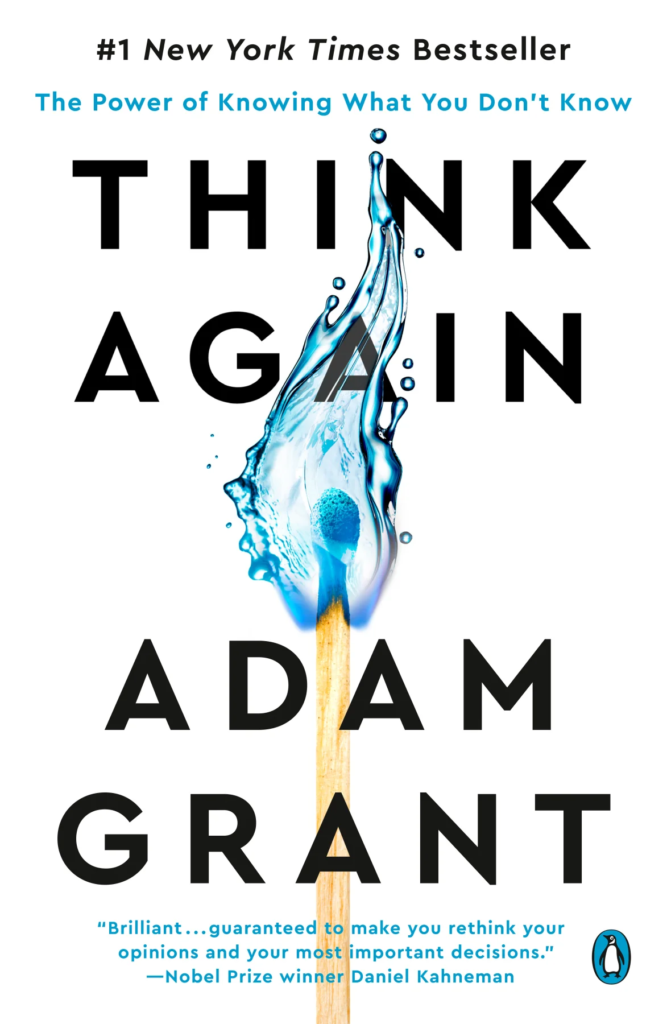
- Author: Adam Grant
- Genre: Non-Fiction, Self-help, Organizational Psychology
- Publisher: VIKING
- Pages: 320
One Sentence Synopsis🔖
Change your mind often, think like a scientist!!
Notes/Thoughts📝
- Confident Humility – the Latin translation of humility is “from the earth”. Being grounded and understanding that we’re all flawed and capable of making errors is the foundation to continuous learning. As mentioned in the book, the visceral hurt we feel at being wrong is often when we wrap our beliefs and identities so tightly together that we cannot separate them; our mental agility gets stuck. We become emotional and stubborn in our positions instead of more curious. Some takeaways from the book:
- The faster you can admit you’re wrong, the faster you can be on the right path
- Imposter syndrome can be advantageous to help us retain our humility as beginners
- The weakness of being good at thinking is you double down on your position – it makes it harder to rethink (let’s get off of the high horse!)
- Going in circles/ruminating doesn’t provide fresh insights so it’s better to actively practice diverting thoughts elsewhere and not mistaking that for reflection
- About disagreeableness – This one is interesting, because in truth, my immediate “challenge network” is not very disagreeable. Maybe it’s a Canadian thing, maybe it’s a Chinese authority thing, maybe it’s the people I surround myself with but disagreeing is conflated with being argumentative, and I don’t agree LOL Hot takes or disagreements are the best way to learn as long as they are conducted respectfully. I understand that the approach is important because being wrong means different things for different people especially if they are conflict avoidant (I’m a recovering conflict avoidant!!) In the last couple of years I’ve realized the power of conversation to change minds both ways and to achieve a level of understanding that improves relationships. Below are some points from the book that gave me some ideas for how I can inspire more learning through conversations:
- Call a spade a spade – call it a debate or make it clear that you want to intellectually spar!
- Ask about the how – explanatory depth is difficult and gives them a chance to provide context instead of both sides presenting shallowing opinions and arguing for the sake of arguing.
- The tone should be “vigorous + feisty” vs “combative or argumentative”. Cultivating this atmosphere has been an uphill battle so I hope to work on this one through more question asking vs. assertions.
- Assess if the person you’re talking to has the capacity to debate!
- Non-fiction gets a bad sometimes for dumbing down the world into neat boxes. What I have forgotten about this genre, and most likely developed over time, is the ability to critique a text. There’s a persuasive argument that’s presented to you and there’s also the job of the reader to read critically and decide whether you agree and why. Here are some things that I didn’t agree with:
- During work book club, someone mentioned about speaking up about child safety to help her neighbours rethink their parenting That was interesting because I recently watched Fjord, and the main premise was the morally grey area between the state being helpful and intrusive when it comes to personal choice, and further to that when the state holds their values as being morally superior. Perhaps Grant wanted to avoid the grey to keep it concise, but this detracted from my reading experience.
- I was low-key irked by the self-help ish vibe of the book. What I don’t like about self-help is the preacher vibes of “If you follow this, then this will happen” which to be fair, the book does acknowledge that people don’t ignore advice because they don’t agree but because they feel that someone is trying to control how they think ( interesting that we fight to retain this freedom – or at least sense of free will!!). Changing people’s, minds in my opinion, is a byproduct of living authentically, that shouldn’t be a goal (it’s very American to convince other people that your view is the right one…).
- I wish there were more practical frameworks included in the book to carry out the rethinking part. The revolving door analogy to inspire quick decision making for things that are reversible and low stakes was a good one, however most of the book focuses on changing your mind which can also lead to an equally unproductive mode of overthinking.
“”
Part of the problem is cognitive laziness. Some psychologists point out that we’re mental misers: we often prefer the ease of hanging on to old views over the difficulty of grappling with new ones. Yet there are also deeper forces behind our resistance to rethinking. Questioning ourselves makes the world more unpredictable. It requires us to admit that the facts may have changed, that what was once right may now be wrong. Reconsidering something we believe deeply can threaten our identities, making it feel as if we’re losing a part of ourselves.
We favor the comfort of conviction over the discomfort of doubt, and we let our beliefs get brittle long before our bones. We laugh at people who still use Windows 95, yet we still cling to opinions that we formed in 1995. We listen to views that make us feel good, instead of ideas that make us think hard.
Under acute stress, people typically revert to their automatic, well-learned responses. That’s evolutionarily adaptive—as long as you find yourself in the same kind of environment in which those reactions were necessary.
Rethinking is a skill set, but it’s also a mindset.
Arrogance is ignorance plus conviction
If knowledge is power, knowing what we don’t know is wisdom.
Her confidence wasn’t in her existing knowledge—it was in her capacity to learn.
Being wrong is the only way I feel sure I’ve learned anything.
Who you are should be a question of what you value, not what you believe.
It’s a sign of wisdom to avoid believing every thought that enters your mind. It’s a mark of emotional intelligence to avoid internalizing every feeling that enters your heart.
The clearest sign of intellectual chemistry isn’t agreeing with someone. It’s enjoying your disagreements with them. Harmony is the pleasing arrangement of different tones, voices, or instruments, not the combination of identical sounds. Creative tension makes beautiful music.
The absence of conflict is not harmony, it’s apathy.
To speak with him was to be seduced by an inverse charisma, a sense of being listened to with such intensity that you had to be your most honest, sharpest, and best self.
There’s a fine line between heroic persistence and foolish stubbornness. Sometimes the best kind of grit is gritting our teeth and turning around.
Leave a Reply